Tuesday, March 29, 2011

WHY TALK?


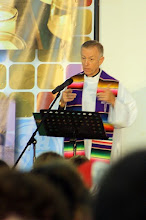
Tonight the Christian-Jewish Dialogue of Mobile is hosting Fr Dennis McManus for a presentation on the state of dialogue especially between Jews and Catholics. Later, on 7 April, our Trialogue (Christians, Jews & Muslims) will be hosting an event with the title “The Sacred Call to Justice.” But for some, the real question is “Why bother?”

It’s a fair question on some levels. It presumes there should be an empirical outcome—one that can be measured and evaluated—to all activity, and if there is none, or if the measurement is minimal, then the activity is deemed worthless.


Their conclusion is that dialogue is exactly such a pointless activity because it produces nothing tangible and beneficial. But is this the case?


Without dialogue I can never get to know another human being as a person. They will remain objects but never subjects. With dialogue we can engage one another, look into each other’s eyes (and, perhaps, also our hearts) and come to understand. When understanding is in fact mutual, it is far easier to be tolerant of differences can that enrich instead of enrage.


There are no doubt some who are fanatically opposed to dialogue. These are typically seen to be Islamist extremists these days, though in fact they scarcely have a corner on the market of intolerance—Jews and Christians, too, are quite capable of these attitudes. But just as some Jews and Christians and Muslims are closed-minded to all perspectives but their own, many, many more are open to coming together for the purpose of respect, recognition of our mutual dignity, and eagerness to learn.


“Hands that reach will touch” is the motto of the Mobile Christian-Jewish Dialogue. It might be expanded: eyes that open will see, ears that listen will hear… To quote Hamlet, surely this is “a consummation devoutly to be wished.”


Friday, March 25, 2011

THE POWER OF A SINGLE WORD

While listening to the St John Passion of Arvo Pärt today, something struck me that hadn’t hit me before: the words of Jesus and Peter are surely deliberately set in opposition to one another.

When Jesus asks whom the soldiers seek in the Garden, and they say, “Jesus of Nazareth,” He replies, “I am he.” In the Latin of Pärt’s setting this is Ego sum (and in the original Greek, ego eimi).


When the attendants in the High Priest’s courtyard ask Peter if he too is a disciple, he responds “I am not.” In the Latin, again, this is Non sum (and in the original Greek, ouk eimi).

Can there be a bigger contrast enclosed in this one word difference? Could the Evangelist possibly have done this by accident? (Hint: the answer to both questions is “No.”)


It’s a stunning reminder that we are to proclaim our faith with boldness, with clarity, with enthusiasm, with utter conviction. Jesus knows who He is: and we do, too—don’t we?


If it is true that Jesus came to make all things new (Rev 21:5), it is our hearts (and our courage) that also need to be made new. How bold are we in our public (not private) commitment to the Lord? Are we among those who say (with Jesus) “It’s me!”? Or are we more like Peter and say “Not me!”? It’s the power of a single word—a single YES, a single (in Latin and Greek, anyway) “I do”…


The world desperately needs public witness of the kind that Isaiah (Is 42) spoke—not crying out, not making our voices heard, yet as a presence which though it does not compel yet cannot be ignored.


Which “word” will we use tomorrow: “I am he,” or “I am not he”?

Wednesday, March 23, 2011

THE LORD HEARS THE CRY OF THE POOR

The shocking truth of this photo is that solidarity with the poor is a risky thing.  31 years ago, on 24 March, Archbishop Oscar Romero of El Salvador was gunned down while celebrating Mass because he spoke against the junta and in favor of the oppressed poor.  Here are his last words, preached before the gunshot that martyred him:

May this body [of the Lord in the Eucharist] immolated and this blood sacrificed for humans nourish us also, so that we may give our body and our blood to suffering and to pain--like Christ, not for self, but to bring about justice and peace for our people.

It is difficult to stand with and for the poor in a way that not only desires to alleviate suffering but also to prevent it by advocating systemic reform.  Dom Helder Camera of Recife, Brazil put it well:  "Why is it that when I reach out to the poor I am called a saint, but when I ask, 'Why are there poor people?' I am called a communist?"

The Chinese proverb is only partially true:  Give a man a fish and you feed him today; teach a man to fish and you feed him for a lifetime.  The man must still be given (have or access to) a rod and reel and bait...

Can we end poverty and suffering?  Probably not--not everyone who is "poor" has the desire to change.  But the vast majority of the world's poor have it imposed on them by circumstances of geography, politics and macro-economics.  And they remain poor because too many of our nations' economic policies do not recognize them as "brothers and sisters we haven't yet met." 

We are blessed to be born and living in a nation that is economically prosperous and free.  What of the rest of the world's people who were not so blessed--do we have any obligations to them?

These are hard questions that do not have easy or simplistic answers.  But I think we have at least the obligation to ask them, and to try to find honest, faith-filled responses to the cry of the poor. 

Tuesday, March 15, 2011

WHAT’S A GOOD (OR THE PERFECT) PRAYER?

There are folks who insist that Catholics who pray the Rosary are not praying properly as we are therefore in violation of Jesus’ words in today’s (Tues of 1st Week of Lent) Gospel (Matt 6:7:15)—“When you pray, do not babble like the hypocrites…”

In that Gospel excerpt, Jesus then offers what many regard as the perfect prayer (some, the only prayer): the Lord’s Prayer. It truly does have everything: it is a prayer that asks for our transformation so that we can be people who overcome evil with good, who forgive others and experience forgiveness themselves, who have the strength to do what needs to be done today for the building of the Kingdom and who long for its completion, and to live lives such that God’s name be kept holy. What more could anyone wish to be?


Yet prayer has other purposes as well, beyond asking: it is a way of entering into communion with the Holy Trinity, a communion of life and love. Can this be done in ways beyond the Lord’s Prayer? No doubt it can.


Prayer of contemplation (simply enjoying being in the Presence) is one such way. Entering into Sacred Scripture (especially on the Ignatian model of placing oneself in the various scenes/episodes of the life of Christ) is another powerful way. And “mantric” prayers like the Rosary (or the Jesus Prayer) are yet another way: they become the underlying music that allows our souls to sing. They are emphatically not babbling many words in order to be heard. They are instead vehicles by which our hearts and minds are lifted up to God in order to be present, attentive, thankful, in love.


How do you pray? What’s the best format for you to come closer to God? In what ways do you find spiritual surrender easiest and most effective? This is what is important in our walk with the Lord. Pray as you can: and when you think you can’t, let the Holy Spirit take over for you (Rom 8:26-27). 

Saturday, March 12, 2011

THE GIFT OF THEOLOGY

In his book Encountering the Mystery, Ecumenical Patriarch Bartholomew makes the fascinating and challenging observation: theology is not a study one does; it is a gift one receives. This would surely be a shock to the faculties at university theology departments, or divinity schools, or seminaries—that many of the Ph.D.s teaching there are not “theologians” in the Patriarch’s sense. What does he mean?
His first comment is that in Orthodox history only three people have been designated with the title “Theologian”—St John the Divine (Fourth Evangelist); St Gregory the Theologian (Gregory Nazianzen), and St Simeon the New Theologian. It is worth noting that many great saints do not make the cut on this criterion: St Athanasius, St Basil, St John Chrysostom, St Gregory Palamas, St John Damascene… So what set these three apart from their noble fellows?


In all three cases it was a mystical experience that was a “donation” of sorts, typically mediated in a vision, which involved receiving the gift of theology as a commission. Interestingly, St John Chrysostom and St Gregory Thaumaturgus (the Wonderworker) were also said to have had the encounter which resulted in their being given the gift, but they are not designated as “theologian.” Nevertheless, these other names all can participate in the gift—and how they do so is pivotal for Bartholomew:


[T]heology is the study of…the Holy Trinity. It is, however, never simply the accumulation of knowledge about the divine nature; …theology is an encounter with the living, personal God: Father, Son and Holy Spirit.
…Thus, theology is always received; it is never merely repeated. It is an act of the Church…
It underlines the importance of theology as encounter and communion; theology is a divine gift to be shared…
If one speaks theologically, then one always does so within the context of an intimate relationship with God, who is the source of all theology.


The Ecumenical Patriarch thus reminds us that the ultimate act of theology is one of prayerful communion with the Trinity—it can never be abstract but always personal and affective and experiential. It is why it is often said that theology cannot properly be “done” except on one’s knees. Libraries are often useful, but on this understanding they are never essential, nor are they ever sufficient. A doctoral dissertation on its own cannot make one a “theologian”…


It is easy to see why his book is titled as it is.  It is a worthy companion for the journey of Lent.

Thursday, March 10, 2011

HAVE MERCY ON ME, O LORD, FOR I HAVE SINNED...

Below, courtesy of Rocco Palmo's Whispers in the Loggia, is the Ash Wednesday homily of Cardinal Justin Rigali of Philadelphia.  In it he refers to the issue of the grand jury's report on priests previously exonerated by the Church re: charges of sexual abuse of minors.  37 cases are being reviewed by the Archdiocese now; 21 priests have been suspended effective immediately.

The tragedy for me is that I tried to listen to Cardinal Rigali's homily with the ears of one of the victims, or of someone from S.N.A.P.--and I am sure such a person would find the homily distressingly inadequate.  It must have sounded to such a person like he was saying we need to repent of such abuse in the same way that we strive during Lent to repent of over-eating or give up smoking.  I am sure the Cardinal is personally devastated by the situation; I am only referring to the impression.  The whole situation has me very, very sad and disheartened...


Wednesday, March 9, 2011

THE GLORY OF THESE 40 DAYS

An  alternative invocation for the imposition of ashes today is "Turn away from sin and be faithful to the Gospel."  They are a slight liturgical variation on the opening words of Jesus in Mark's Gospel:
     This is the time of fulfillment.  The kingdom of God is at hand.  Repent, and believe in the gospel (Mk 1:15).

Are we ready to repent?  Of course, this presupposes we think we have things from which to repent!  Yet in our quieter moments we know this is the case:  what will happen to us this Lent that will allow us (encourage us, even) to die to self in some specific way(s), so to live in the Lord more intimately?

Psalm 51 (our Response at Mass today) is attributed to King David after being accused of the blatant adultery with Bathsheba and murder of her husband, Uriah.  He was accused; he confessed his sin.  We might do well to examine our consciences and confess our sins as well, even if they are not such monstrous evils as David's.  To that end I am offering a classic performance of the classic Ash Wednesday composition:  Gregorio Allegri's Miserere.  While for some of us the adaptation to the text of the King James Bible, sung by the choir of King's College, Cambridge is the first and best of all recordings, this one by the Tallis Scholars (in the original Latin) is at least equally delightful.  Enjoy, and may our Lenten journey bring us that much closer to the Lamb of God.