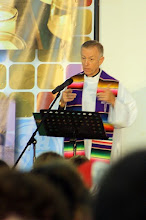
Today’s Solemnity (in most of the world moved from its traditional date of the Thursday after Trinity Sunday to this, the following Sunday) is a celebration of what we as Catholics hold most central and dear to our liturgical spirituality: the Eucharist.
The readings for Cycles A, B and C offer special Scriptural launching pads for our prayer on this day:
From Cycle A, we are reminded that we do not live on bread alone; that God feeds us with the finest wheat; that the blessing cup and the loaf are not only a participation in the Blood and Body of Christ but are intended to bring us into unity; that Jesus is the Bread of Life.
Cycle B teaches us about the blood of the original covenant at Sinai; it celebrates the ‘cup of salvation’ offered at the Passover commemoration of Exodus and Covenant; it reminds us of the high priesthood of Jesus; it makes explicit the connection of the Last Supper with the Passover.
Cycle C (this year’s readings) present us with the bread and wine of Melchizedek’s thank-offering to Abram; the tie-in with Melchizedek’s eternal priesthood; the institution of the Eucharist as St Paul presents it; and the foreshadowing of it through the multiplication of loaves for the thousands gathered to feast also on the Word.
Any one of these readings, much less all of them, could be the stuff of a good, sustained prayer of thankfulness for this Sacrament (which after all is named from the Greek word which gives us ‘thanksgiving’).
As a priest I must honestly admit that sometimes distractions afflict me in the course of the celebration of the Eucharist. I must also admit that there, at the altars of Word and Sacrament, I feel most ‘at home’ in my ordained ministry. Distractions, yes; boredom, no; not in 20 years of priestly life. I have only gratitude to God for so many gifts, including the gift of peace in my heart for my vocation (even when challenged and stressed out by daily circumstances).
It needs to be stated, too, that the Body to be “discerned” (I Corinthians 11:29—just past the excerpt selected for today’s 2nd reading) is not only the sacramental Body of Christ but also the Mystical Body, of which we are the members under His Headship. How do we live the Eucharist, beyond attending (hopefully, truly celebrating) church on Sunday?
If Jesus promises to be with us always (Matthew 28:16-20), He also says He will be found in the least of our brothers and sisters (Matthew 25:31-46). Are we ready to “worship” inside and outside the church?
As a prayerful bonus, I am adding below a setting of Panis Angelicus, and a less familiar setting of Ave, Verum Corpus, by Gabriel Faure, to celebrate the day. Enjoy, and blessed discerning of the Body to us all!
Sunday, June 6, 2010


Monday, May 31, 2010
MEMORIAL DAY REMEMBRANCES, RETREATS AND NIMROD
The train of thought I’m expressing here was triggered by a post by my blogging hero, Rocco Palmo, on “Whispers in the Loggia.” It is a performance of the “Nimrod” variation from Sir Edward Elgar’s Enigma Variations, played for Remembrance Day in England. The quality of the music speaks for itself as to why it is chosen for this occasion. But why would I also choose it?
There is much that we need to remember on Memorial Day when we think of ultimate sacrifices: I think of the Honor Flight which brings World War II veterans to Washington, DC for a special tribute and visit to the WWII Memorial. One of our own parishioners, Paul Hogan, made the trip last year. He, a survivor, did honor to those who gave their lives in the course of the combat to break the Nazi war machine and the machinations of Adolf Hitler. And I think of the ultimate of all sacrifices for freedom, fought and won almost 2,000 years ago on a cross on a hill outside Jerusalem. Every of Eucharist is a “Memorial Day” for us…
But as I prepare (along with the other priests of our Archdiocese) to enter into retreat, my mind goes back several years to another retreat. It was at Spring Hill College, and we were gathering in the Gautrelet Room for the afternoon conference when Msgr James Oberkirk heard a joke, laughed, and dropped to the floor with a massive heart attack. He was given CPR by Fr. Paul Halladay (and anointed by another priest) and was rushed to Spring Hill Memorial, but he died that day. We were all shaken by what had happened right in front of us. And after the conference, we moved slowly to St Joseph Chapel for Adoration and Evening Prayer—and the organist just happened to be playing “Nimrod” as we entered, not knowing what had happened (the organist, Chris Uhl, was a close friend of Fr Oberkirk). It was surreal, and tremendously appropriate.
On this Memorial Day, please remember those who have fallen for the sake of freedom; please remember those who have passed into the true Sanctuary after a lifetime of ministering in sanctuaries here; and pray for all of us who remain to be dedicated to the freedom which truly sets us free (John 8:34-36). We are all called to be ‘soldiers of Christ’ in spiritual warfare. May we be armed with the virtues (Eph 6:10-17) that enable us, in Him, to persevere and share in the victory.
Below is a performance of “Nimrod” for your Memorial Day pleasure, performed by the Chicago Symphony Orchestra, led by Daniel Barenboim.
There is much that we need to remember on Memorial Day when we think of ultimate sacrifices: I think of the Honor Flight which brings World War II veterans to Washington, DC for a special tribute and visit to the WWII Memorial. One of our own parishioners, Paul Hogan, made the trip last year. He, a survivor, did honor to those who gave their lives in the course of the combat to break the Nazi war machine and the machinations of Adolf Hitler. And I think of the ultimate of all sacrifices for freedom, fought and won almost 2,000 years ago on a cross on a hill outside Jerusalem. Every of Eucharist is a “Memorial Day” for us…
But as I prepare (along with the other priests of our Archdiocese) to enter into retreat, my mind goes back several years to another retreat. It was at Spring Hill College, and we were gathering in the Gautrelet Room for the afternoon conference when Msgr James Oberkirk heard a joke, laughed, and dropped to the floor with a massive heart attack. He was given CPR by Fr. Paul Halladay (and anointed by another priest) and was rushed to Spring Hill Memorial, but he died that day. We were all shaken by what had happened right in front of us. And after the conference, we moved slowly to St Joseph Chapel for Adoration and Evening Prayer—and the organist just happened to be playing “Nimrod” as we entered, not knowing what had happened (the organist, Chris Uhl, was a close friend of Fr Oberkirk). It was surreal, and tremendously appropriate.
On this Memorial Day, please remember those who have fallen for the sake of freedom; please remember those who have passed into the true Sanctuary after a lifetime of ministering in sanctuaries here; and pray for all of us who remain to be dedicated to the freedom which truly sets us free (John 8:34-36). We are all called to be ‘soldiers of Christ’ in spiritual warfare. May we be armed with the virtues (Eph 6:10-17) that enable us, in Him, to persevere and share in the victory.
Below is a performance of “Nimrod” for your Memorial Day pleasure, performed by the Chicago Symphony Orchestra, led by Daniel Barenboim.
Saturday, May 29, 2010
TERRIFYING STATISTICS
In a recent essay in America (May 24, 2010, p. 16), former Secretary of Health, Education and Welfare Joseph Califano writes:
Consider these three facts: We in the United States make up 5 percent of the world’s population. We consume 66 percent of the world’s illegal drugs. We incarcerate 25 percent of the world’s prisoners.
This is a terrifying statement about our culture. It says that the simple declaration of an action or an object as illegal is not “The Answer” to eliminating it from our lives. It reminds us of the truth (presented so humorously by Fr. Guido Sarducci in his 5-Minute University) that economics is all about supply and demand. If there is a demand, there will be a supply.
It is why there are drug wars and drug lords, in Mexico, in Colombia, in Afghanistan, in the United States. Too many people see no other way to make money, and they want to be part of the supply for America’s demands, and they take enormous risks (and often act with enormous brutality) to satisfy those cravings and make that money.
Perhaps this suggests that the “War On Drugs” has been focusing on the wrong enemy…
Consider these three facts: We in the United States make up 5 percent of the world’s population. We consume 66 percent of the world’s illegal drugs. We incarcerate 25 percent of the world’s prisoners.
This is a terrifying statement about our culture. It says that the simple declaration of an action or an object as illegal is not “The Answer” to eliminating it from our lives. It reminds us of the truth (presented so humorously by Fr. Guido Sarducci in his 5-Minute University) that economics is all about supply and demand. If there is a demand, there will be a supply.
It is why there are drug wars and drug lords, in Mexico, in Colombia, in Afghanistan, in the United States. Too many people see no other way to make money, and they want to be part of the supply for America’s demands, and they take enormous risks (and often act with enormous brutality) to satisfy those cravings and make that money.
Perhaps this suggests that the “War On Drugs” has been focusing on the wrong enemy…
LIFE AND DEATH IN ALABAMA
A prayerful vigil was held Thursday afternoon (5-27) in front of the Cathedral of the Immaculate Conception in Mobile—a vigil to mark the execution of Thomas Whisenhant for rape and murder, and to pray for his victim, Cheryl Payton, and her family. The majority of those present at the vigil were from Our Savior parish.
My comment there was simple enough: what Thomas Whisenhant did to Cheryl Payton back in 1976, was evil. He may or may not have been morally responsible (seeing that he was also earlier diagnosed as psychotic with paranoid schizophrenia). But taking his life was not the answer.
The feelings of Ms Payton’s family, as expressed in Friday’s Mobile Press-Register, confirm this, it seems to me. Before he died, Mr Whisenhant smiled and tried to lift up his left hand to respond to those who supported him. Relatives, the news article stated, saw this as an act of hostility. Why? Were they only seeing him through the lens of anger (surely understandable, but which blurs the vision nevertheless)?
Beyond this, Ms Payton’s brother was quoted as saying, “There really wasn’t justice served today. We watched him die an easy death.” Perhaps he did. But if death itself is not the point of capital punishment, what else would have been necessary to satisfy the family? “He died a much easier death than my wife,” Ms Payton’s widower, Douglas, said. Does this mean that we need (or that people want) to inflict death by torture rather than by lethal injection? Is death itself not the point…?
Please—I regard the rage and the hurt and the anger of the Payton family as completely understandable. But these feelings lead to expressions of a desire that is really about revenge and not about “justice being served” or experiencing “closure.” The rage and hurt and anger go on, even after the execution. And this family does not deserve to be held in the grip of these feelings—no family does.
This is why the most painful thing they could be asked to do is the one thing that can release them and heal them—it is the act of forgiveness. They cannot be reconciled with Mr Whisenhant now (they probably never could). But if they could begin to pray for peace for him, as well as for their beloved Cheryl; if they could begin to pray for themselves, for the grace and strength to let go the hate; they could begin to become whole persons again. They deserve this.
My comment there was simple enough: what Thomas Whisenhant did to Cheryl Payton back in 1976, was evil. He may or may not have been morally responsible (seeing that he was also earlier diagnosed as psychotic with paranoid schizophrenia). But taking his life was not the answer.
The feelings of Ms Payton’s family, as expressed in Friday’s Mobile Press-Register, confirm this, it seems to me. Before he died, Mr Whisenhant smiled and tried to lift up his left hand to respond to those who supported him. Relatives, the news article stated, saw this as an act of hostility. Why? Were they only seeing him through the lens of anger (surely understandable, but which blurs the vision nevertheless)?
Beyond this, Ms Payton’s brother was quoted as saying, “There really wasn’t justice served today. We watched him die an easy death.” Perhaps he did. But if death itself is not the point of capital punishment, what else would have been necessary to satisfy the family? “He died a much easier death than my wife,” Ms Payton’s widower, Douglas, said. Does this mean that we need (or that people want) to inflict death by torture rather than by lethal injection? Is death itself not the point…?
Please—I regard the rage and the hurt and the anger of the Payton family as completely understandable. But these feelings lead to expressions of a desire that is really about revenge and not about “justice being served” or experiencing “closure.” The rage and hurt and anger go on, even after the execution. And this family does not deserve to be held in the grip of these feelings—no family does.
This is why the most painful thing they could be asked to do is the one thing that can release them and heal them—it is the act of forgiveness. They cannot be reconciled with Mr Whisenhant now (they probably never could). But if they could begin to pray for peace for him, as well as for their beloved Cheryl; if they could begin to pray for themselves, for the grace and strength to let go the hate; they could begin to become whole persons again. They deserve this.
Wednesday, May 26, 2010
A BRILLIANT ORATORIAN INSIGHT

St. Philip Neri (feast day today—26 May) was known for “aphorisms”—short, pithy sayings that were rather like proverbs in their intent (especially those found in the Biblical Book of Proverbs). A selection of them was offered as a meditation today in Magnificat, and one in particular struck me:
Not everything which is better in itself is better for each man in particular.
I suppose some people may think this obvious—a truism of sorts. But how many of us chase after what seems to be beneficial for others (and seems desirable “in itself”), never considering that we are not “others.” How many of us find ourselves following career paths because they are expected of us, especially if our Fathers or Mothers enjoyed that career. The most superficial glance at British history will show that simply being the son of a king does not make you able to be a good king yourself. Edward II and Henry VI, for example, would have been far happier, far better off, and probably longer-lived, had the throne not been part of what was expected of them…
This is really a meditation on the meaning of vocation. In order to know who and what I can be as a person, I have to have a realistic knowledge of who and what I am, and how I came to be what I am. This takes serious and in-depth introspection—real soul-searching—to find out what my memories are, and how they have shaped me (for better or for worse) into the person I am now. Only then can I ask myself the intimate question, “Given all that I have experienced and all the choices I have made, and what it all has made me to be, for better and for worse: given who and what I am now—what life-style, what vocation, what career is truly suited for me, to make me authentically happy and allow me scope to exercise my unique gifts?” Sometimes, by the way, brokenness can be one of these “unique gifts”—think of people in AA ministering to other alcoholics…
It might mean becoming a Trappist monk; it might mean becoming a surgeon; it might mean having eight children; it might mean working for NASA—it might mean a hundred thousand other possibilities. And we need to choose one, not because it seems to work for others, but because it is right for me.
This brings me to the greatest of all Oratorians (after St. Philip, of course!)—John Henry Newman. He knew no Catholics as friends; he had scant experience of the Catholic Church in practice. But his theology led him to the doorstep of the Church, and as he agonized about his future, he wrote:
The simple question is, Can I (it is personal, not whether another, but can I) be saved in the English Church? am I in safety, were I to die to-night? Is it a mortal sin in me, not joining another communion? (Apologia Pro Vita Sua)
We all know the answer Newman finally arrived at to these questions, but the key is that he was not advocating a universal antidote but a specific prescription—for himself.
We all have back-stories (as TV show producers refer to them). We all are the sum of our experiences and choices up until this point, making us who and what we are. We all need to ask, “OK, God—given all this—what would you have me do?”
Not everything which is better in itself is better for each man in particular.
I suppose some people may think this obvious—a truism of sorts. But how many of us chase after what seems to be beneficial for others (and seems desirable “in itself”), never considering that we are not “others.” How many of us find ourselves following career paths because they are expected of us, especially if our Fathers or Mothers enjoyed that career. The most superficial glance at British history will show that simply being the son of a king does not make you able to be a good king yourself. Edward II and Henry VI, for example, would have been far happier, far better off, and probably longer-lived, had the throne not been part of what was expected of them…
This is really a meditation on the meaning of vocation. In order to know who and what I can be as a person, I have to have a realistic knowledge of who and what I am, and how I came to be what I am. This takes serious and in-depth introspection—real soul-searching—to find out what my memories are, and how they have shaped me (for better or for worse) into the person I am now. Only then can I ask myself the intimate question, “Given all that I have experienced and all the choices I have made, and what it all has made me to be, for better and for worse: given who and what I am now—what life-style, what vocation, what career is truly suited for me, to make me authentically happy and allow me scope to exercise my unique gifts?” Sometimes, by the way, brokenness can be one of these “unique gifts”—think of people in AA ministering to other alcoholics…
It might mean becoming a Trappist monk; it might mean becoming a surgeon; it might mean having eight children; it might mean working for NASA—it might mean a hundred thousand other possibilities. And we need to choose one, not because it seems to work for others, but because it is right for me.
This brings me to the greatest of all Oratorians (after St. Philip, of course!)—John Henry Newman. He knew no Catholics as friends; he had scant experience of the Catholic Church in practice. But his theology led him to the doorstep of the Church, and as he agonized about his future, he wrote:
The simple question is, Can I (it is personal, not whether another, but can I) be saved in the English Church? am I in safety, were I to die to-night? Is it a mortal sin in me, not joining another communion? (Apologia Pro Vita Sua)
We all know the answer Newman finally arrived at to these questions, but the key is that he was not advocating a universal antidote but a specific prescription—for himself.
We all have back-stories (as TV show producers refer to them). We all are the sum of our experiences and choices up until this point, making us who and what we are. We all need to ask, “OK, God—given all this—what would you have me do?”
ON DEATH AND DYING

Thomas Whisenhant is scheduled to be executed on 5-27 as a result of his conviction of rape and murder of Cheryl Payton. He was found guilty more than 30 years ago.
There will be a prayer vigil in front of the Cathedral in Mobile at 4:30 tomorrow afternoon because of this execution. I will be there (as I usually am, when executions occur in our State).
At the vigil we pray, sing and share. First and foremost we pray for the families both of victim and criminal. We do not pretend that those who are executed are somehow all innocent and are being railroaded; we know most are in fact guilty of the fact of the crime, even if (as Mr Whisenhant’s lawyers argued) he was legally insane at the time.
I am sorry that Ms Payton’s family members have experienced such suffering for the last 30 years. But I want to offer a couple of observations on executions in general.
First of all, when families think there can be no “closure” until the murderer is executed, what happens when the crime’s punishment is determined to be “life imprisonment without hope of parole”? Does this mean there can never be “closure”? I also know (anecdotally) that families sometimes do not have peace even after an execution ends the life of one who ended the life of someone they loved. And the additional tragedy is that, regardless, the life of the victim will not be able to be restored.
If family and friends of a victim could let go of their anger and forgive (this does NOT mean excusing the criminal or saying anything that justifies an evil action), they could find peace and “closure” far earlier. The anger is what eats at them, and it makes them bitter. They need healing, too; they do not deserve to live in the grip of outrage and hatred. Forgiveness
is the only way of dealing with these overwhelming emotions. The “Truth and Reconciliation Commission” in South Africa taught us this, after apartheid was finally ended in that country. The United Nations’ “Nelson Mandela International Day” will mark this leader’s 92nd birthday—18 July. Why wait? Why not ask for the grace to begin the process of forgiveness and healing now?
Executions are unworthy of us as a civilization. Opposing capital punishment does not mean some people have not committed great evil; it means that taking another life does not solve the problem and only makes us the more callous and vengeful. This may be a meaningful legal response, but it is not the Christian response. “An eye for an eye” was a good law in times when the lust for revenge was out of control. Can we not move forward a little, as a society, toward the Sermon on the Mount? It’s time… --isn't it?
There will be a prayer vigil in front of the Cathedral in Mobile at 4:30 tomorrow afternoon because of this execution. I will be there (as I usually am, when executions occur in our State).
At the vigil we pray, sing and share. First and foremost we pray for the families both of victim and criminal. We do not pretend that those who are executed are somehow all innocent and are being railroaded; we know most are in fact guilty of the fact of the crime, even if (as Mr Whisenhant’s lawyers argued) he was legally insane at the time.
I am sorry that Ms Payton’s family members have experienced such suffering for the last 30 years. But I want to offer a couple of observations on executions in general.
First of all, when families think there can be no “closure” until the murderer is executed, what happens when the crime’s punishment is determined to be “life imprisonment without hope of parole”? Does this mean there can never be “closure”? I also know (anecdotally) that families sometimes do not have peace even after an execution ends the life of one who ended the life of someone they loved. And the additional tragedy is that, regardless, the life of the victim will not be able to be restored.
If family and friends of a victim could let go of their anger and forgive (this does NOT mean excusing the criminal or saying anything that justifies an evil action), they could find peace and “closure” far earlier. The anger is what eats at them, and it makes them bitter. They need healing, too; they do not deserve to live in the grip of outrage and hatred. Forgiveness
is the only way of dealing with these overwhelming emotions. The “Truth and Reconciliation Commission” in South Africa taught us this, after apartheid was finally ended in that country. The United Nations’ “Nelson Mandela International Day” will mark this leader’s 92nd birthday—18 July. Why wait? Why not ask for the grace to begin the process of forgiveness and healing now?
Executions are unworthy of us as a civilization. Opposing capital punishment does not mean some people have not committed great evil; it means that taking another life does not solve the problem and only makes us the more callous and vengeful. This may be a meaningful legal response, but it is not the Christian response. “An eye for an eye” was a good law in times when the lust for revenge was out of control. Can we not move forward a little, as a society, toward the Sermon on the Mount? It’s time… --isn't it?
Thursday, May 20, 2010
THE SPIRIT AND THE CHURCH

Scripture readings at Mass yesterday (Wednesday of the 7th Week of Easter) included the final part of Paul’s farewell speech on the island of Miletus (Acts 20) and a middle portion of Jesus’ priestly prayer for unity (John 17). The two contained over-arching themes that really work well for telling us things about ourselves as Christians of varying denominations.
Paul insists there will be “savage wolves” to attack the Church [from outside], and also from within “men…perverting the truth” in order to lead others into schism. It is a view that is repeated, in its own way, in the Fourth Gospel and letters of John: it is a view, “retrojected,” if you like, into Apostolic times, of the experience of the post-Apostolic Church communities.
Why should these things happen? Jesus gives us the answer: “But if it is by the finger of God that I cast out demons [and Satan’s kingdom with it], then the kingdom of God has come upon you” (Luke 11:20). And Satan won’t go down without a fight. Attacks and infiltrations are what we must expect, and we should be utterly vigilant against both. Our situation today shows that we have not been vigilant enough with regard to infiltrations, and this means not only the “faith” issues explicitly referred to by Paul, but also the “morals” issues of what we do in our lives that is contradictory to the Gospel we preach.
We are a divided body, and we are divided bodies. As was emphasized several times at the National Workshop on Christian Unity (a conference I attended in April), there are splits within denominations that are at least as serious as those between denominations, especially with regard to views of what is proper in the realm of sexuality.
Yet Jesus prays that we would be united in Him as He is in the Father. We hear and recognize the call, but we are not always ready to listen and follow. Our various denominations all need the refiner’s fire to purify us; we need tremendous individual and collective repentance; we need to be open to the re-forming in His image that the Holy Spirit’s fire can bring. The Latin phrase is Ecclesia semper reformanda: the Church, ever in need of reform. This doesn’t mean us only in the past and others now—it means us all, always. Otherwise, as Gamaliel told the Sanhedrin, we might even find ourselves fighting against God (Acts 5:39)
Here is a good focus for the final days of the “Novena to Pentecost”—to quote a contemporary hymn, “Let the fire fall”/”Come, Holy Spirit”/“Come, Lord Jesus.”
Paul insists there will be “savage wolves” to attack the Church [from outside], and also from within “men…perverting the truth” in order to lead others into schism. It is a view that is repeated, in its own way, in the Fourth Gospel and letters of John: it is a view, “retrojected,” if you like, into Apostolic times, of the experience of the post-Apostolic Church communities.
Why should these things happen? Jesus gives us the answer: “But if it is by the finger of God that I cast out demons [and Satan’s kingdom with it], then the kingdom of God has come upon you” (Luke 11:20). And Satan won’t go down without a fight. Attacks and infiltrations are what we must expect, and we should be utterly vigilant against both. Our situation today shows that we have not been vigilant enough with regard to infiltrations, and this means not only the “faith” issues explicitly referred to by Paul, but also the “morals” issues of what we do in our lives that is contradictory to the Gospel we preach.
We are a divided body, and we are divided bodies. As was emphasized several times at the National Workshop on Christian Unity (a conference I attended in April), there are splits within denominations that are at least as serious as those between denominations, especially with regard to views of what is proper in the realm of sexuality.
Yet Jesus prays that we would be united in Him as He is in the Father. We hear and recognize the call, but we are not always ready to listen and follow. Our various denominations all need the refiner’s fire to purify us; we need tremendous individual and collective repentance; we need to be open to the re-forming in His image that the Holy Spirit’s fire can bring. The Latin phrase is Ecclesia semper reformanda: the Church, ever in need of reform. This doesn’t mean us only in the past and others now—it means us all, always. Otherwise, as Gamaliel told the Sanhedrin, we might even find ourselves fighting against God (Acts 5:39)
Here is a good focus for the final days of the “Novena to Pentecost”—to quote a contemporary hymn, “Let the fire fall”/”Come, Holy Spirit”/“Come, Lord Jesus.”
Subscribe to:
Posts (Atom)